

Exosome serums deliver tiny, cell-produced signalling vesicles directly into your skin that trigger repair, stimulate collagen production, and improve hydration at a level most traditional serums simply cannot reach. In published clinical trials, topical exosome formulations have produced wrinkle reductions of 12–14%, elasticity improvements of over 11%, and measurable decreases in pigmentation — results backed by peer-reviewed research, not just marketing claims.
If you've been hearing the word "exosome" everywhere in 2026 and wondering whether it's genuinely different or just another passing trend, I can tell you as a doctor who works with skin daily: the science behind this one is real.
But here's the part that most skincare articles won't tell you: not all exosome serums are created equal, and you don't need to spend $200–$300 to get genuine results. The source material, the formulation stability, and the supporting ingredients matter far more than the price tag.
What Are Exosomes, and Why Should Your Skin Care About Them?
Think of exosomes as microscopic delivery packages that your cells naturally produce to communicate with each other. They're nanoscale vesicles — we're talking 30 to 150 nanometres, roughly a thousand times smaller than the width of a human hair — enclosed in a lipid bilayer membrane that protects a potent cargo of proteins, growth factors, microRNAs, and signalling molecules. When these vesicles reach a target cell, they essentially hand-deliver a set of biological instructions: repair this damage, produce more collagen, calm this inflammation, speed up healing.
In clinical settings, exosomes have been studied extensively in regenerative medicine for wound healing, tissue repair, and anti-inflammatory applications. Their skincare application is a natural extension of that research. The cargo they carry includes key growth factors like EGF (which stimulates keratinocyte proliferation), TGF-β (a master regulator of collagen synthesis), FGF (which triggers fibroblast activity), and VEGF (which supports microvascular health). Beyond proteins, exosomes carry functionally active microRNAs that can actually reprogram how your skin cells behave. One particular microRNA found in adipose-derived exosomes, miR-1246, has been shown to suppress the enzymes (matrix metalloproteinases) that break down your existing collagen by approximately 66–70%.
What makes exosomes particularly exciting compared to older active ingredients is their mechanism. While hyaluronic acid pulls moisture in, and retinol forces cell turnover, exosomes communicate. They work across at least six major cellular signalling pathways simultaneously — including TGF-β/Smad for collagen synthesis, PI3K/Akt for cell survival, and NF-κB inhibition for reducing inflammation. They work with your skin's biology rather than overriding it. For people with sensitive skin who've struggled with irritation from retinoids or acids, that's a meaningful distinction.
Exosome Serum vs. Hyaluronic Acid: Do You Need Both?
This is one of the most common questions I get, and the honest answer is: they do completely different things, and ideally, yes, you benefit from both.
Hyaluronic acid is a humectant. It draws water to the surface of your skin and holds it there — it can bind up to 1,000 times its weight in water. It's brilliant at short-term hydration and plumping. But it doesn't repair. It doesn't rebuild. It doesn't communicate with your cells. High-molecular-weight HA can't even penetrate the stratum corneum; it forms a hydrating film on the surface. Lower-molecular-weight HA gets slightly deeper, achieving roughly 14–19% penetration to the epidermis and dermis. Think of hyaluronic acid as filling your skin's water tank.
Exosomes, on the other hand, are the repair crew. They signal your skin to produce its own collagen, calm inflammation, and accelerate healing at a cellular level. Here's what most people miss: exosomes actually stimulate your fibroblasts to produce endogenous hyaluronic acid — your skin's own supply — by activating TGF-β, MAPK/ERK, and PI3K/AKT pathways. So while topical HA hydrates from the outside in, exosomes rebuild your skin's hydration capacity from the inside out.
The short version: Hyaluronic acid fills the tank. Exosomes fix the plumbing. Use both — exosome serum first on clean skin, then layer your hydrator on top.
In my own practice, I recommend using both. An exosome serum in the morning for cellular repair, radiance, and long-term structural improvement, layered under a moisturiser that supports hydration and barrier function. If you're building a minimalist routine, the exosome serum often replaces multiple products because it's doing so many things at once — but it does not replace your hydrator. They're partners, not competitors.
Plant-Derived vs. Human-Derived Exosomes: What's the Real Difference?
Not all exosome serums use the same source material, and this matters more than most brands will admit.
Human-derived exosomes are typically sourced from lab-grown mesenchymal stem cells — often from adipose tissue, umbilical cord, or platelets. They carry growth factors (TGF-β, VEGF, FGF-2, PDGF-BB, EGF) and human-relevant microRNAs already optimised for human skin biology. In clinical trials, human-derived exosomes combined with microneedling produced that 12–14% wrinkle reduction and 11% elasticity improvement I mentioned earlier. Their limitation? Stability. They require −80°C storage for long-term preservation, and repeated freeze-thaw cycles degrade membrane integrity. That cold-chain dependency is why human-derived exosome serums typically retail between $150 and $300+ per bottle.
Plant-derived exosome-like nanovesicles come from botanical sources — centella asiatica, ginseng, green tea, grape cells, and other regenerative plants. They carry a fundamentally different cargo: phytochemicals like polyphenols and flavonoids, alongside plant-specific microRNAs capable of cross-kingdom gene regulation. A 2022 keratinocyte study found that plant-derived exosomes upregulated 861 genes in skin cells after just six hours of exposure — more than double the 398 genes activated by conventional plant extracts. In wound-healing assays, plant exosomes achieved complete wound closure in 24 hours versus 52% for untreated controls. Their major advantage is stability: room-temperature storage with shelf lives of up to two years.
The honest take? Human-derived exosomes may have a slight edge in potency for aggressive anti-ageing, particularly when delivered through professional procedures. But for daily topical use — the way most people actually use a serum — a well-formulated plant-derived exosome product delivers outstanding results. Plant exosomes actually show superior skin penetration in topical application, with studies demonstrating two-times greater penetration efficiency compared to controls.
There's also a regulatory reality. In the EU and UK, human-derived exosomes are effectively prohibited in cosmetic products under current regulations. Plant-derived alternatives are permissible when safety-evaluated, which is why they currently represent approximately 39% of the exosome skincare category by product count — and that share is growing rapidly.
What Should You Look for in an Exosome Serum?
The exosome market is getting crowded fast. The broader exosome skincare market is projected to grow at 10–13% annually through the end of this decade. But not every product labelled "exosome" deserves the name. Here's what I tell my patients:
- Source transparency. Does the brand tell you where the exosomes come from? Plant-derived, human-derived, or something else? If a product says "exosome technology" without specifying the source, be cautious.
- Formulation stability. Exosomes are delicate structures. Look for serums rather than heavy creams — lightweight, low-water formulas preserve exosome integrity better. How the product is stored and shipped matters too.
- Supporting ingredients. The best exosome serums include complementary actives like hyaluronic acid, peptides, collagen, or allantoin that work synergistically — addressing repair, hydration, and structural support simultaneously.
- Realistic claims. Clinical evidence shows 12–14% wrinkle reduction and measurable elasticity improvements over weeks of consistent use. That's genuinely encouraging. But any brand promising to "reverse ageing by 10 years" is selling hope, not science.
- Price perspective. Human-derived exosome serums run $150–$300+ per bottle. Plant-derived formulations start around $20–$50. The price gap doesn't always reflect an equivalent gap in daily topical results.
What Does the Latest Clinical Research Actually Show?
I want to be transparent about the state of the science, because I think you deserve an honest assessment rather than cherry-picked claims.
The clinical evidence for exosome skincare is real and growing. The largest published trial enrolled 56 participants using a topical platelet-derived exosome formulation twice daily for six weeks. Results showed statistically significant reductions in redness, wrinkles, and melanin production, with 98% of participants expressing willingness to continue treatment. Adverse events were limited to mild dryness in about 16% of users — no serious side effects.
A 2023 split-face randomised trial — the gold standard of study design — compared exosome treatment against a control across 28 participants over 12 weeks. The exosome-treated side showed wrinkle parameter reductions of 12–14%, elasticity improvement of over 11% versus a 3% worsening on the control side, and a melanin index reduction of nearly 10%. Histological analysis confirmed greater collagen and elastic fibre density under the microscope.
Perhaps the most intriguing finding came from a 2024 study published in Dermatologic Surgery, which demonstrated that topical exosomes reduced cellular senescence markers — the proteins that signal "cell ageing" — significantly, with pro-inflammatory ageing markers dropping by 40% in high-baseline patients. This suggests exosomes may address skin ageing at its molecular root, not just at the surface.
What the research also tells us honestly: sample sizes remain small, follow-up periods are relatively short, and the strongest results come when exosomes are combined with professional procedures that disrupt the skin barrier. For daily topical use on intact skin, the results are more modest but still clinically meaningful — especially with consistent, long-term application.
How Does an Exosome Serum Fit Into a Simple Routine?
One of the things I appreciate most about exosome serums is that they simplify routines rather than complicating them. Because exosomes are multifunctional — working on hydration, repair, collagen support, and radiance simultaneously — a single serum can often replace two or three separate products.
☀️ Morning
- Cleanser (or water rinse)
- Exosome Serum
- Probiotic Day Cream
- SPF 30–50
🌙 Evening
- Purifying Cream Cleanser
- Retinol Cream
That's it. Four products, two minutes, twice a day. No 10-step routines, no ingredient conflicts, no confusion about layering order. Every product has a clear, non-overlapping purpose. Every step builds on the one before it. And the exosome serum is the engine that makes the morning routine work — delivering repair signals while your barrier cream and SPF protect and preserve those benefits throughout the day.
Why I Built an Exosome Serum Into the Breeze & Be System
When I set out to create Breeze & Be, the exosome serum was the product I spent the most time formulating. I wanted to bring genuine exosome technology into a routine that people could actually afford and actually use every day — not a $250 bottle that sits on a shelf because it feels too precious to apply liberally.
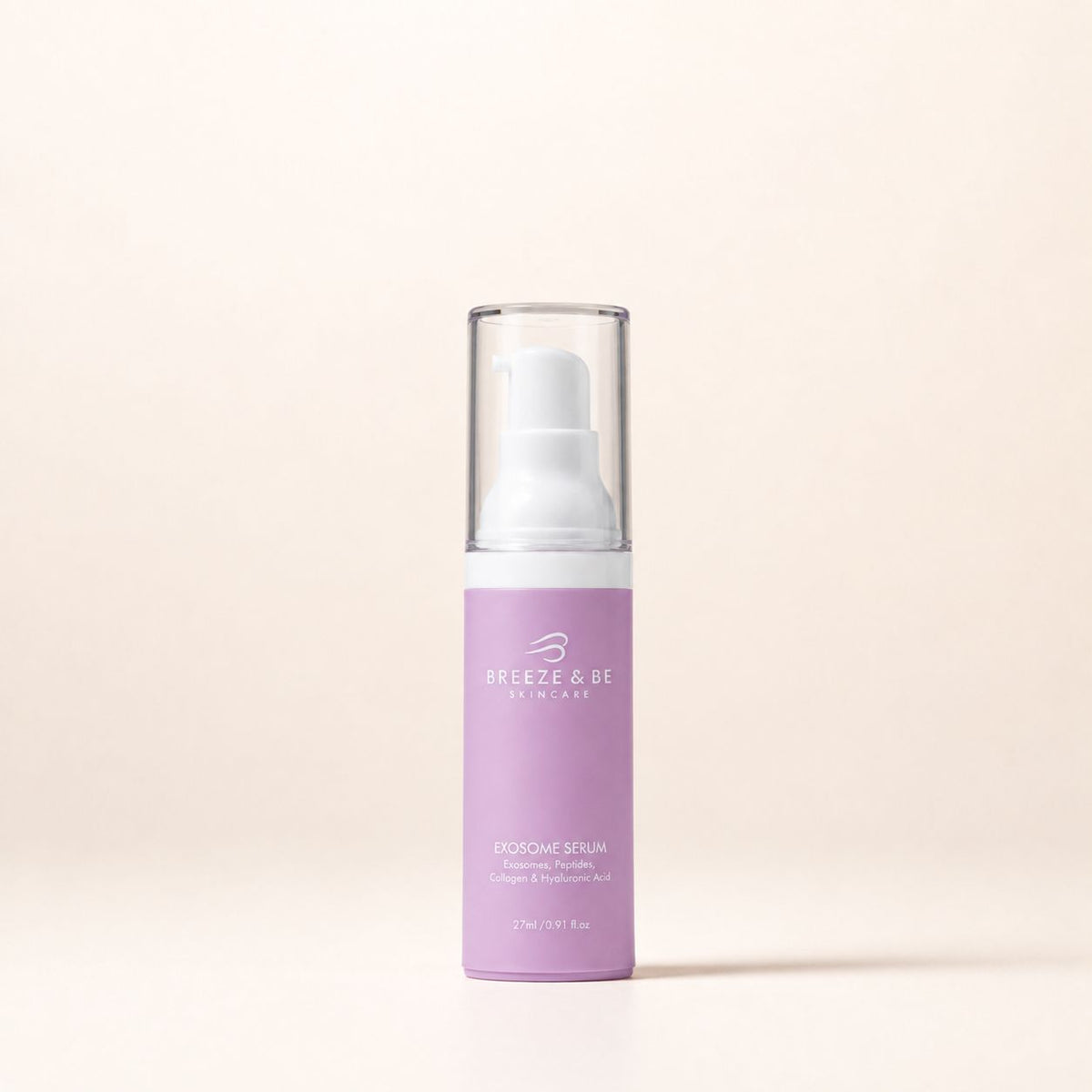
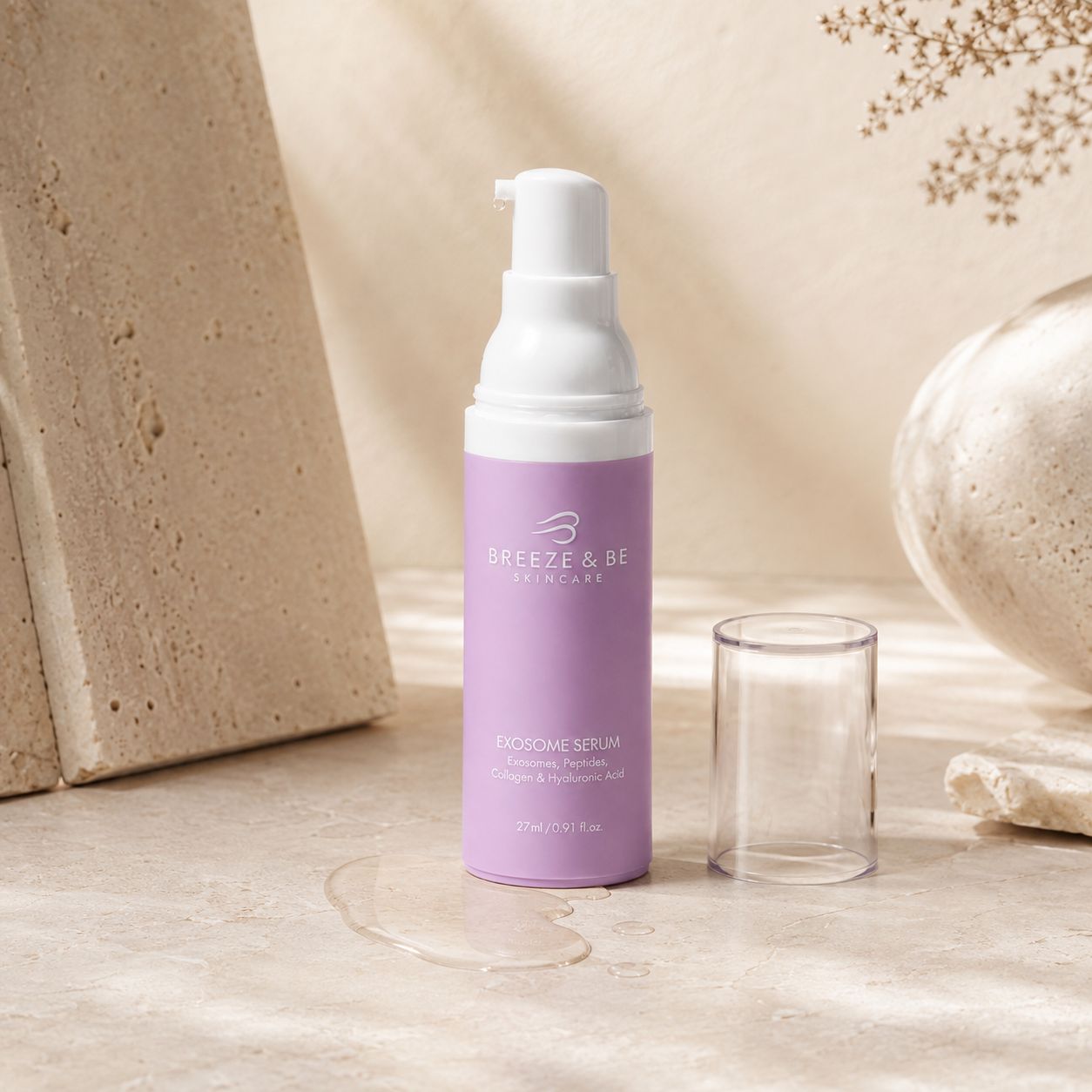
The Breeze & Be Exosome Serum combines exosome technology with peptides (including Myristoyl Pentapeptide-4 and Dipeptide Diaminobutyroyl Benzylamide Diacetate for fine-line smoothing), soluble collagen for immediate plumping, multi-molecular-weight sodium hyaluronate for layered hydration, and allantoin and grape cell extract for soothing and antioxidant protection. It's a lightweight, non-sticky formula that absorbs in seconds and layers beautifully under moisturiser and SPF.
Every ingredient was chosen because the science supports it — and because it works in concert with the other three products in the system. The serum feeds your skin's repair mechanisms in the morning; the Probiotic Day Cream protects the microbiome and seals in those benefits; the Purifying Cream Cleanser resets your skin in the evening; and the Retinol Cream amplifies overnight cell turnover.
4 Products. 1 Routine. Real Results.
The Complete Skin Reset Bundle — exosome serum, probiotic cream, retinol cream & cleanser — for $119 $165
Shop the Bundle Exosome Serum — $50The Bottom Line
Exosome skincare isn't a fad. The science behind it is serious — peer-reviewed clinical trials showing measurable wrinkle reduction, elasticity improvement, pigmentation correction, and even reduced cellular ageing markers. What's changing in 2026 is accessibility: you no longer need a $300 serum or an in-office procedure to benefit from exosome technology.
If you're considering adding an exosome serum to your routine, focus on source quality, formulation stability, supporting ingredients, and how it fits with your existing products. Pair it with hyaluronic acid-based hydration for the best results — they're complementary, not competing. Be patient; meaningful results develop over weeks of consistent use, not overnight.
And if you want a simple, doctor-developed option that combines exosome technology with peptides, collagen, and multi-weight hyaluronic acid in a complete routine — that's exactly what I built Breeze & Be to be.